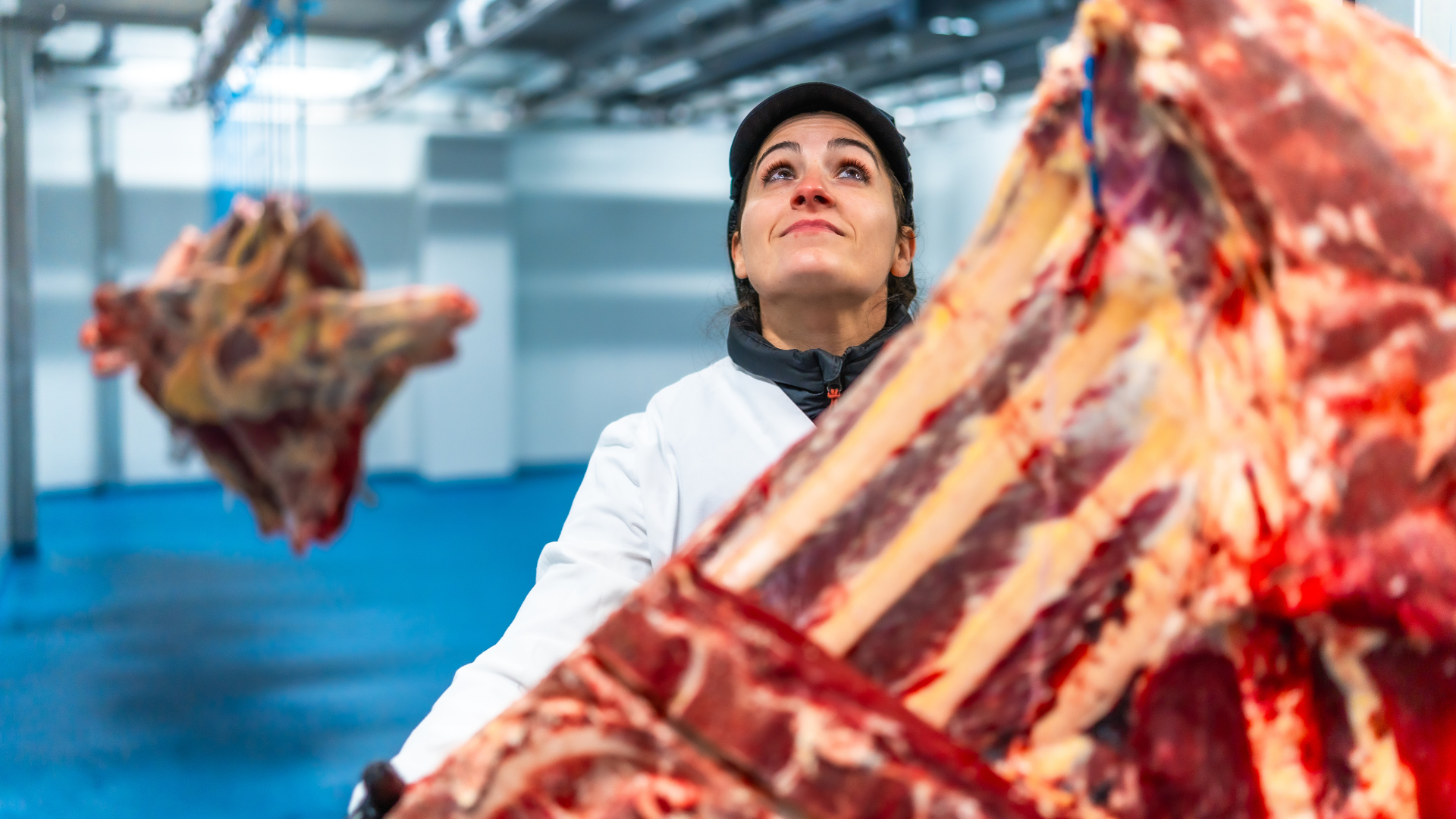
Birrail overhead rail is a twin-track overhead conveying system in which the trolley runs guided by two parallel aluminium profiles, so it cannot leave the track or derail along the route. That makes it the safest option for moving carcasses and meat cuts in slaughterhouses, cutting rooms and cold stores: the load travels balanced and the risk of a carcass falling on an operator is eliminated.
At Bernad® we have been designing, manufacturing and installing overhead rail systems since 1987. In this article we explain what the Birrail system is, why its twin-track design is safer than flat-bar or monorail systems, and which components make up a complete installation.
What is Birrail overhead rail?
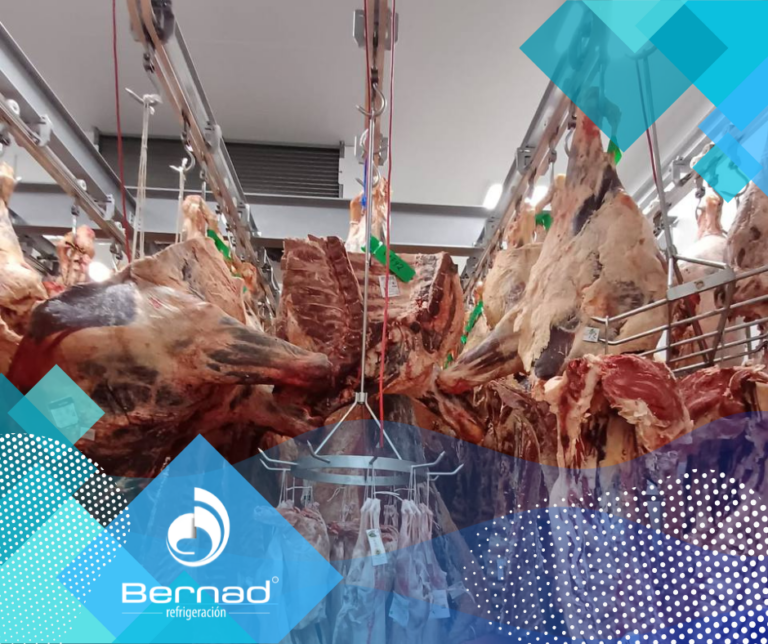
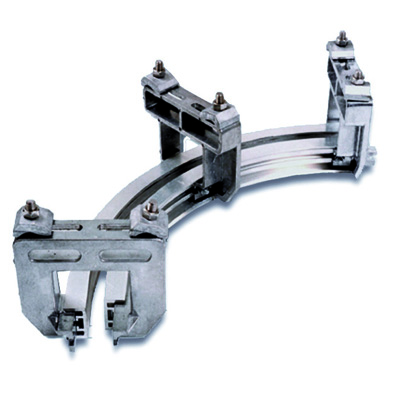
Birrail overhead rail (also called twin-track rail or double-track road network) is a suspended conveying system for the meat industry. It is made of two extruded aluminium alloy profiles, joined in a single twin rail, on which the trolleys carrying the meat on hooks, gambrels, hangers or pendants run.
The rail is anchored to the building structure with aluminium saddles with anchoring flanges and stainless steel screws, fixed into a special groove in the profile. Straight sections, curves and switches are combined to build the rail network that runs through the whole plant, from the slaughter line to the cold rooms and dispatch.
Why can’t Birrail derail?
Birrail safety does not depend on how careful the operator is, but on the geometry of the system itself. These are the key design points:
- Twin rail with a guided trolley. The trolley does not hang from a single flat bar: its nylon wheels and rollers run on the two parallel profiles of the rail, which keep it centred and guided along the whole route. By design, the trolley cannot slide off the track sideways.
- Balanced load. The weight is shared between the two profiles and stays centred under the trolley. The carcass does not tend to tip or push the trolley to one side, even when it swings as it is pushed.
- Curves and switches with continuous guidance. In curves, a set of inner and outer aluminium arches (350 mm radius) gives continuity to the track, and in switches a stainless steel direction needle steers the trolley onto the chosen track. The trolley stays guided exactly where the risk of leaving the track is highest.
- End stops. Stainless steel end stops are fitted at the end of each section so that trolleys cannot run off the rail.
- Anchoring sized to the load. The straight section has saddles approximately every 75 cm, and the spacing between saddles is adjusted to the load each installation has to carry. In tensile tests reproducing real working conditions, the Birrail system has performed far above the demands it faces in practice.
The result is a system in which trolley, load and rail work together: the trolley cannot derail and the carcass cannot fall from the track because of a guidance failure, which is precisely the type of accident that worries cutting rooms most.
Common risks of flat-bar and monorail systems
Flat-bar and monorail overhead systems are based on a single profile on which a roller or hook runs. They are simple, but their design concentrates the load on one support point and leaves the trolley less guided. In practice this can lead to:
- The trolley or hook coming off when the load swings, is knocked or is pushed hard.
- Derailment in curves, switches and rail joints, where the trolley changes direction and a single rail holds it less securely.
- Falling loads, with a risk of impact and entrapment for staff working under or next to the track, as well as product loss.
- Greater reliance on the operator, who has to guide the load more carefully to stop it swinging or coming off.
From an occupational health and safety point of view, reducing the chance of a suspended load falling is one of the most effective measures in slaughterhouses and cutting rooms. The twin-track design acts directly on that risk.
Comparison: Birrail vs flat bar vs monorail
| Criterion | Birrail (twin track) | Flat bar | Monorail |
|---|---|---|---|
| Derailment risk | The trolley runs guided between two profiles and cannot leave the track | Higher: single support, the trolley can come off | Higher: a single rail holds the trolley less securely |
| Falling load | Load centred and shared between two profiles | Possible if the trolley or hook comes loose | Possible with knocks, swinging or in curves |
| Curves and switches | Inner and outer arches and stainless direction needle guide the trolley | Critical points of the route | Critical points of the route |
| Hygiene | Aluminium, stainless screws and nylon wheels, easy to clean | Depends on material and finish | Depends on material and finish |
| Maintenance | Nylon wheels replaceable without stopping the installation; modular system | Depends on manufacturer | Depends on manufacturer |
| Load capacity | Network calculated for each use by adjusting saddle spacing | Depends on installation | Depends on installation |
| Extensions | Modular: sections, curves and switches are added to the existing network | Depends on system | Depends on system |
Applications of Birrail overhead rail
Birrail is used wherever hanging meat has to be moved continuously, hygienically and safely:
- Slaughterhouses: conveying pig, cattle and sheep carcasses from the dressing line to chilling and cold rooms.
- Cutting rooms: moving cuts between workstations without lifting weight by hand.
- Cold stores: tidy storage of hanging product, making the most of the space.
- Drying rooms and dispatch: ham hangers, pendants and truck loading with truck entries and swing arms.
Components of a Birrail installation
A Bernad® Birrail rail network is built with these elements, all available in our twin-track rail section:
- Complete double-track network: straight section with rail, saddles and screws, ready to install.
- Double-track rail: extruded aluminium rail only, in 4 m bars, to extend or replace sections.
- Single saddles and double saddles in aluminium, with anchoring flanges and stainless screws.
- Horizontal curves at 45° and 90° and curve arches.
- Single switches and triple switches, with stainless direction needles.
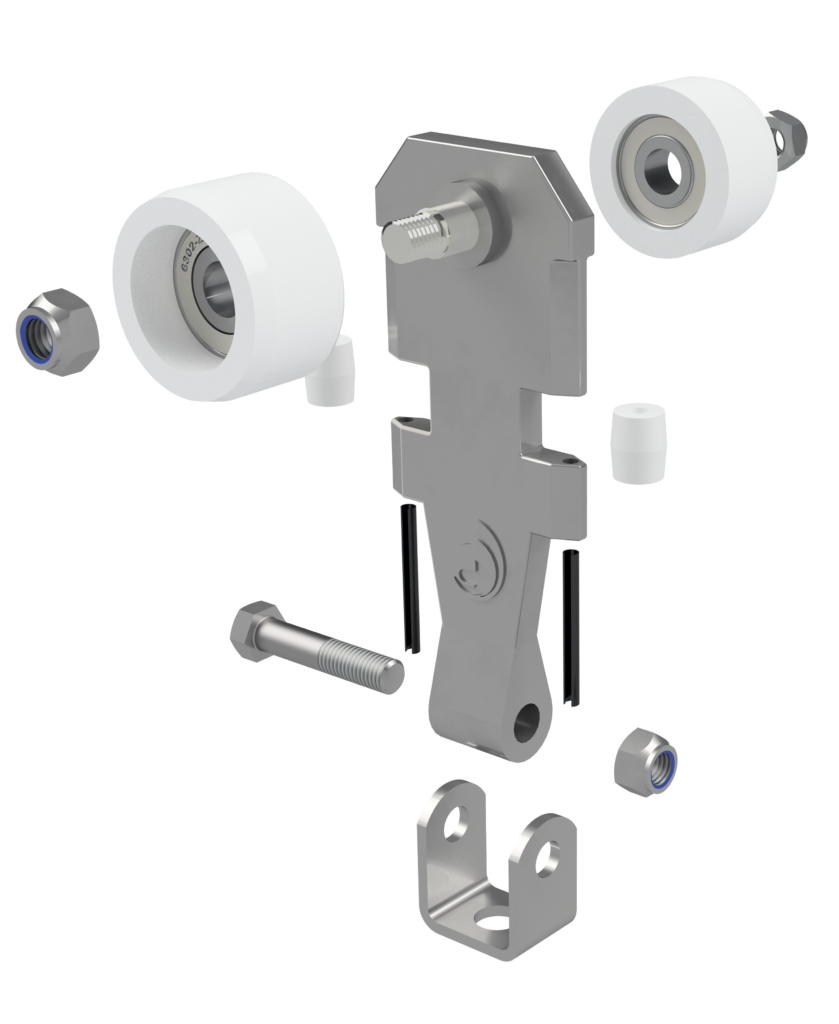
- Trolleys with stainless hook and 4-wheel trolleys, with spare nylon wheels.
- Stainless end stops to close each section.
The network is supported by a primary structure of galvanised iron columns and beams, designed to suit each plant.
Why choose Bernad® for your installation
- Manufacturers and installers of food industry equipment since 1987.
- More than 20,700 customers and more than 2,500 projects in 10 countries.
- In-house manufacturing in AISI 304 stainless steel and aluminium overhead rail with stainless screws.
- Custom design of every rail network and quotes answered in less than 24 hours.
Frequently asked questions about Birrail overhead rail
It is a twin-track overhead conveying system for the meat industry: two parallel extruded aluminium profiles on which the trolleys carrying the hanging meat run.
No. The trolley runs guided between the two profiles of the rail, also in curves and switches, so it cannot leave the track. At the end of each section, end stops prevent the trolley from running off.
Flat-bar and monorail systems support the trolley on a single profile; Birrail guides it between two. This shares the load, stops the trolley coming off and reduces the risk of a carcass falling on an operator.
The rail, arches and saddles are aluminium; the screws and direction needles are stainless steel, and the trolleys have nylon wheels.
It depends on each installation: the network is calculated for the expected load by adjusting the spacing between saddles, which is about 75 cm on the standard section.
Yes. The system is modular: rail sections, curves and switches can be added, or damaged sections replaced, without replacing the whole network.
Conclusion: safety starts with the design of the track
Choosing overhead rail is not just a question of capacity or price: it is deciding how much risk your staff take every time they push a carcass. With the twin-track Birrail system the trolley is always guided, the load travels balanced and derailment is removed as a cause of accidents. If you are planning a new installation or want to replace a flat-bar or monorail track, we will help you design it to measure.
👉 Request your quote (answer in less than 24 hours) · 📞 +34 967 219 649 · 💬 Message us on WhatsApp