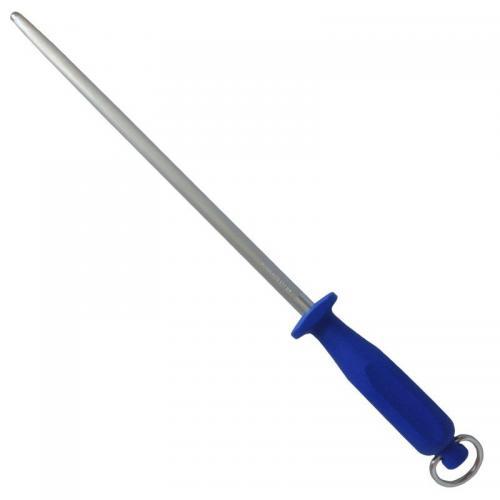
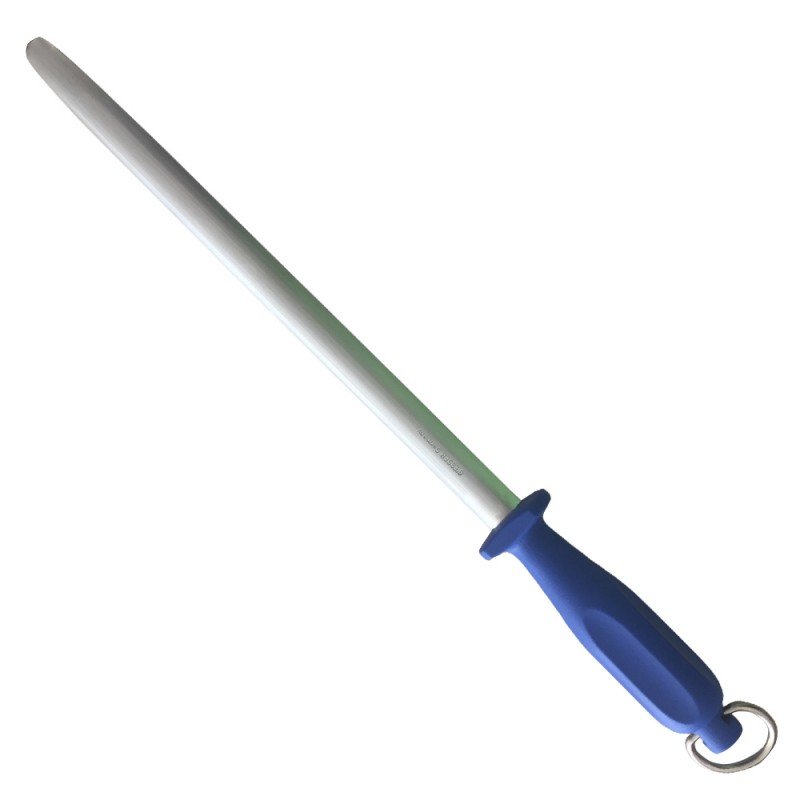
Oval-section steel sharpening steel, 31 cm, with a blue polyethylene handle. More contact surface per stroke than a round steel, so long blades are realigned in fewer movements.

Description
The professional oval sharpening steel, 31 cm, brings a knife’s edge back in a few strokes. Its oval-section steel offers more contact surface than a round one, and the blue handle makes the utensil easy to identify in handling areas.
What it is used for
A steel does not sharpen, it realigns. In use, the very fine edge folds microscopically to one side and the knife stops going in, even though it has lost no material. A few strokes of the steel return that edge to position and the cut comes back instantly. It is the habit that separates someone who sharpens once a week from someone who sharpens once a month.
- Butchery: a touch-up between cuts, without leaving the counter.
- Cutting rooms: maintaining the edge through a whole shift.
- Professional kitchens: a routine gesture before every service.
- Delicatessen: portioning and filleting knives.
- Fishmongers: fine blades that lose their edge quickly.
Technical specifications
| Type | Professional steel sharpening steel |
| Steel section | Oval |
| Length | 31 cm |
| Handle colour | Blue |
Oval or round: what the section actually changes
The difference is the contact area. An oval section presents a wider band of steel to the blade on each stroke, so a long blade is covered in fewer movements. A round section concentrates the contact along a narrower line, which some operators prefer because it gives a more precise feel of where the edge is meeting the steel.
Both do the same job, and neither is technically superior. In practice the choice comes down to the length of the knives and the habit of whoever uses it: long butcher’s blades favour the oval, detailed work on small blades often favours the round. If a team has always used one, changing it rarely improves anything.
The coloured handle follows a widespread practice in food production: assigning a colour to each zone or product type to avoid cross-contamination. It is a simple measure that usually appears among the procedures of the HACCP plan required by Regulation (EC) No 852/2004, and it also makes any detached fragment easier to spot.
What the supply includes
- Professional oval steel sharpening steel, 31 cm, with blue handle.
This is a touch-up tool. When the steel no longer brings the cut back, the knife needs sharpening on a machine.
Advice and service from Bernad®
José Bernad, S.L. has spent nearly 40 years equipping butchers, preparation rooms and kitchens. We are a team of 35 with our own in-house technical service. We supply knives, steels, sharpeners and their consumables, so the whole cycle of the edge is handled by one supplier.
We can help you set the maintenance routine for your knives: what to touch up daily, when to sharpen, and with which machine.
Frequently asked questions
What is the difference between an oval and a round steel?
The section. The oval offers more contact surface on each stroke, which helps work long blades with fewer movements. The round concentrates contact along a narrower line. Both do the same job; the choice is one of preference and habit.
How often should the steel be used?
Often, with few strokes, not the other way round. In butchery the norm is to touch up several times through the day, even between cuts. Waiting until the knife will not cut forces a real sharpening, which consumes material from the blade.
Does a steel sharpen the knife?
No, and this is the most widespread confusion. Sharpening removes metal and rebuilds the bevel; a steel only straightens the folded edge. That is why it greatly extends the interval between sharpenings, but does not replace them.
Why 31 cm?
Because the steel should be at least as long as the blade being touched up, so it can be covered in a single movement. 31 cm comfortably covers the usual butchery set, including long butcher’s knives.
How should it be stored?
In a knife holder or hung by its ring, never loose among the blades. Storing knives piled together is one of the most frequent causes of lost edges, because the blades knock against each other.
Alternatives and related products
- Professional round sharpening steel 31 cm: the same length with a round-section steel.
- Manual knife sharpener: a touch-up fixed to the counter, with no steel to hold.
- DICK RS75 sharpener: for real sharpening when touching up is no longer enough.
- Stainless steel knife holder 4/2: somewhere to keep knives and steel without damaging them.
Additional information
| Weight | 1 kg |
|---|