Description
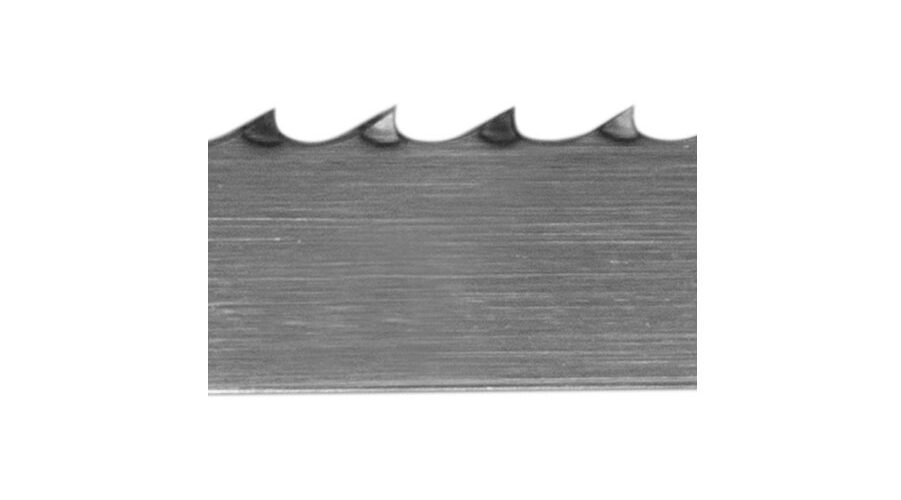
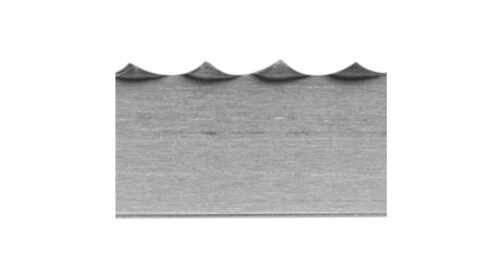
The 1836 mm bone band saw blade is made from laminated carbon steel with a special pearled tooth rated for double life. It matches saws taking an 1836 mm band and passes through bone with a clean cut and no residue. Supplied in a box of four blades.
Band type: BONE (4 TPI). Tooth size: 6.35 mm (4 teeth per inch). A very balanced option for bone-in meat and for improving the look of the cut. Especially suited to machines with a linear speed below 20 m/s. Dimensions: 1,836 × 16 × 0.50 mm (length × width × thickness).
What an 1836 mm bone blade is used for
This is the bone version of a workshop size. On these machines bone cutting is done in series and with pieces of some size, so the tooth works continuously and wear advances faster than it would on a counter saw.
- Meat preparation room: whole loin racks and rib racks.
- Butcher’s shop: daily cutting of bone-in pieces.
- Supermarket: meat sections with a preparation room.
- Catering: cutting up pieces for the menu.
- Cutting room: separating sections that have not been boned.
Technical specifications
| Band length |
1,836 mm |
| Dimensions |
1,836 × 16 × 0.50 mm (length × width × thickness) |
| Tooth type |
4 TPI (4 teeth per inch) |
| Tooth size |
6.35 mm (4 teeth per inch) |
| Teeth per inch (TPI) |
4 |
| Recommended use |
Bone-in meat: a very balanced option that improves the look of the cut. |
| Machine speed |
Especially suited to machines with a linear speed below 20 m/s |
| Application |
Cutting bone |
| Material |
Laminated carbon steel |
| Tooth profile |
Special pearled tooth, double life |
| Cut finish |
Clean, no residue |
| Performance |
High |
| Supply |
Box of 4 blades |
What to do if the band breaks while you are cutting
It is the situation that frightens people most and the one most worth having thought through. If the band breaks mid-cut, the first thing is not to try to hold on to anything: step back and hit the emergency stop.
Afterwards, before fitting a new band, find out why it broke: too much tension, worn guides, a spent band or the wrong material for that version. Fitting another without checking the cause usually ends with the second band breaking exactly like the first.
What the supply includes
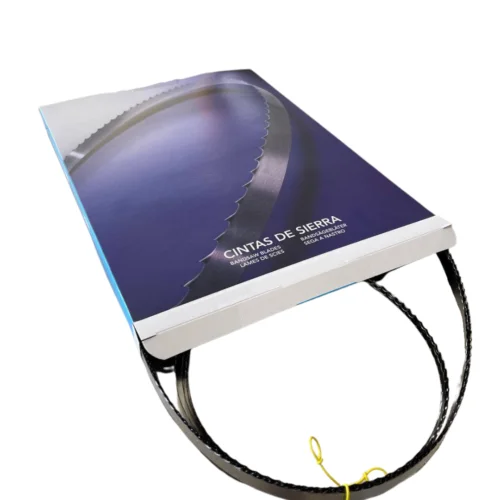
Box of four 1836 mm band saw blades for cutting bone.
The same length is available in a version for fresh meat.
Frequently asked questions
Which band do I need: meat, bone or frozen?
It depends on what you cut and on your saw’s linear speed (it is in the manual; if you do not know it, call us on +34 967 219 649 with the make and model). The three versions, in this length:
- MEAT (half-moon): 7 mm (half-moon) tooth. Recommended for fresh meat. Dimensions: 1,836 × 16 × 0.40 mm (length × width × thickness). See the 1,836 mm meat band.
- BONE (4 TPI): 6.35 mm (4 teeth per inch) tooth. A very balanced option for bone-in meat and for improving the look of the cut. Especially suited to machines with a linear speed below 20 m/s. Dimensions: 1,836 × 16 × 0.50 mm (length × width × thickness). (this blade)
- FROZEN (3 TPI): 8.46 mm (3 teeth per inch) tooth. Recommended for frozen product: a more aggressive cut and high production volume. Works especially well on machines with a linear speed above 20 m/s. Dimensions: 1,836 × 16 × 0.50 mm (length × width × thickness). Not in our range at 1,836 mm: see other lengths in Saw Blades.
Why do bands break?
Fatigue in the steel. The usual causes are excessive tension, worn guides forcing the blade sideways, a band already past its life, and cutting material the version was not made for. It is nearly always one of those four.
What do I do if it breaks while I am cutting?
Step away and stop the machine with the emergency button. Do not try to hold the piece or the band. Wait until everything has come to a complete stop before opening any guard.
Can a broken band be repaired?
Welding bands is specialist work and, at the lengths and prices usual in butchery, it rarely pays. The practical answer is to replace it and set the broken one aside for disposal as scrap metal.
How often should I check the tension?
When fitting each band and periodically afterwards, because the steel gives slightly with use. Many machines have an indicator; if yours does not, follow the figure in the manufacturer’s manual.
Does the tension change with the material?
The correct tension is set by the machine manufacturer, not by the material. What does change is how much it matters: cutting bone, a badly set tension turns into a breakage far sooner than it would on fresh meat.
How do I know what blade length my saw needs?
The number in the product name (1600, 1820, 2330…) is the blade length in millimetres, and it must match exactly the length specified by your saw’s manufacturer on the rating plate or in the manual. If you have no documentation, measure the old blade laid out along its full circumference. Bernad® can help you confirm the length your machine takes.
How many blades come in a box, and how should I store spares?
Four blades, folded to take up less space and travel protected. Store them in their box, somewhere dry and with nothing heavy on top: moisture rusts carbon steel and crushing deforms the blade. When unfolding them, wear gloves and leave space around you, because the blade springs back into shape suddenly.
Other lengths and blade types