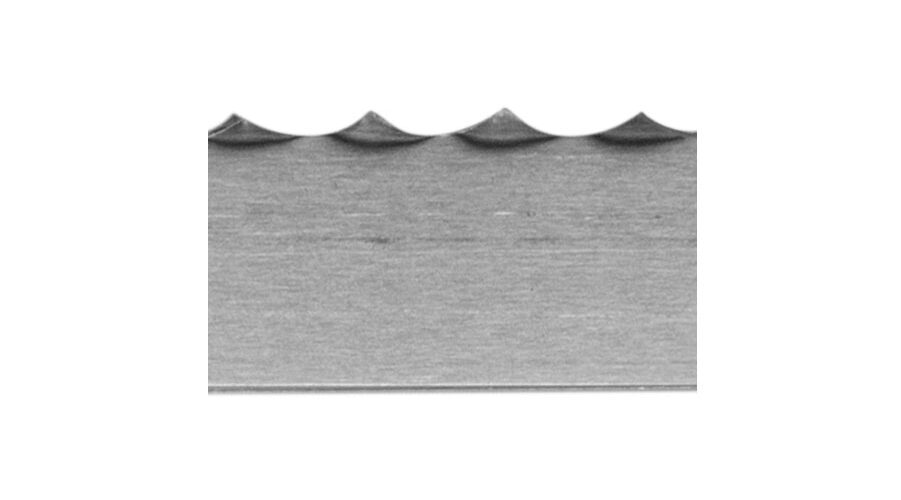
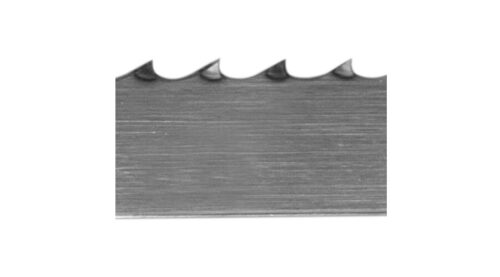
Box of 4 band saw blades, 1,600 mm, for meat (half-moon tooth), high performance for a clean, residue-free cut.
Tooth size: 7 mm (half-moon).
Recommended for fresh meat.
Dimensions: 1,600 × 16 × 0.40 mm (length × width × thickness).

24,20€ + VAT / box of 4
Box of 4 band saw blades, 1,600 mm, for meat (half-moon tooth), high performance for a clean, residue-free cut.
Tooth size: 7 mm (half-moon).
Recommended for fresh meat.
Dimensions: 1,600 × 16 × 0.40 mm (length × width × thickness).
The 1600 mm band saw blade for meat is the shortest length in the range and the one that fits compact counter-top and small workshop band saws. It is designed for cutting fresh meat, from fine slicing through to boning, and comes in a box of four hardened blades that give a clean cut with no residue.
Band type: MEAT (half-moon). Tooth size: 7 mm (half-moon). Recommended for fresh meat. Dimensions: 1,600 × 16 × 0.40 mm (length × width × thickness).
On a band saw the blade is the consumable that decides the quality of the cut and, to a large extent, how safe the work is. A blade in good condition cuts without the operator having to push the piece into it, and that is the whole point: force applied to the piece is what causes accidents on this type of machine.
| Band length | 1,600 mm |
| Dimensions | 1,600 × 16 × 0.40 mm (length × width × thickness) |
| Tooth type | Half-moon |
| Tooth size | 7 mm (half-moon) |
| Recommended use | Fresh meat. |
| Application | Cutting fresh meat |
| Tooth geometry | Optimised, precision ground |
| Resistance | High abrasion resistance, holds its edge under heavy use |
| Supply | Box of 4 blades |
The number that identifies each blade — 1600, 1820, 2330 — is its length in millimetres, and it does not tolerate approximation: it has to match exactly the figure specified by the manufacturer of your band saw. A blade that is too short will not close over the wheels and one that is too long cannot be tensioned, and in either case the machine is unusable.
That length is tied to the size of the machine and therefore to the cutting height it accepts. Compact counter-top saws run blades of 1600 to 1800 mm and cut medium-sized pieces; workshop saws use 1900 to 2300 mm; and cutting-room and industrial machines take blades above 2300 mm, able to pass bulky pieces and carcasses. If you do not know the size your machine takes, the most reliable method is to measure the old blade or check the machine’s rating plate.
The band saw is one of the highest-risk machines in a preparation room. As equipment it falls, which require guards covering the band except at the cutting zone, an emergency stop device and a system that prevents accidental start-up. In practice, three rules: never remove the guards, always use the pusher to feed the piece into the blade, and replace the blade when it loses its cut, because a blunt band forces the operator to push and multiplies the risk.
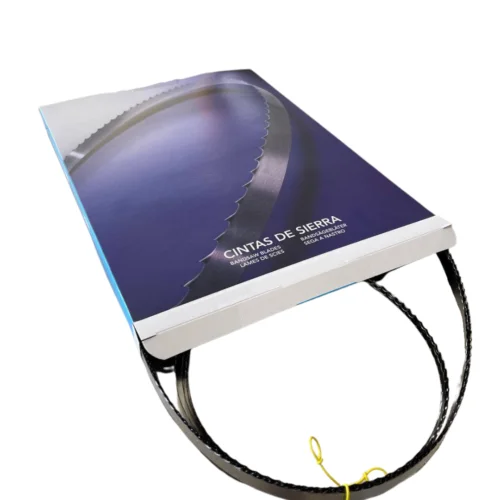
Box of four 1600 mm band saw blades for cutting fresh meat.
The same length is available in a bone version, and other lengths cover the rest of the machine range.
Product with CE marking.
It depends on what you cut and on your saw’s linear speed (it is in the manual; if you do not know it, call us on +34 967 219 649 with the make and model). The three versions, in this length:
It is the length of the band in millimetres. It has to match exactly what your saw’s manufacturer specifies, because there is no tolerance margin: the blade must sit on the wheels and tension correctly. Measure your old band or check the machine’s rating plate if you are not sure which length you need.
The tooth design. The meat blade is made for cutting fresh product and leaves a clean finish when slicing; the bone version has teeth built to pass through hard tissue without tearing. Used on bone, it wears out very quickly and spoils the quality of the cut.
When it stops cutting on its own and you have to push the piece, when the cut wanders off line, or when broken teeth appear. Working with a spent band is the most common cause of a blade breaking mid-cut, with the risk that carries for whoever is standing at the machine.
Coiled in their packaging, somewhere dry, and never crushed under weight. A band that has been bent or stored under load is permanently deformed and no longer runs true on the wheels, so the cut comes out uneven from the first day it is fitted.
In professional practice blades are replaced, not sharpened. The teeth are very fine and their geometry is what determines the cut; restoring it needs specific equipment and rarely makes sense against the price of a new band.
| Weight | 0,2 kg |
|---|---|
| Multiplo |
No reviews for this product yet. Only customers who have purchased it can leave a review.