Description
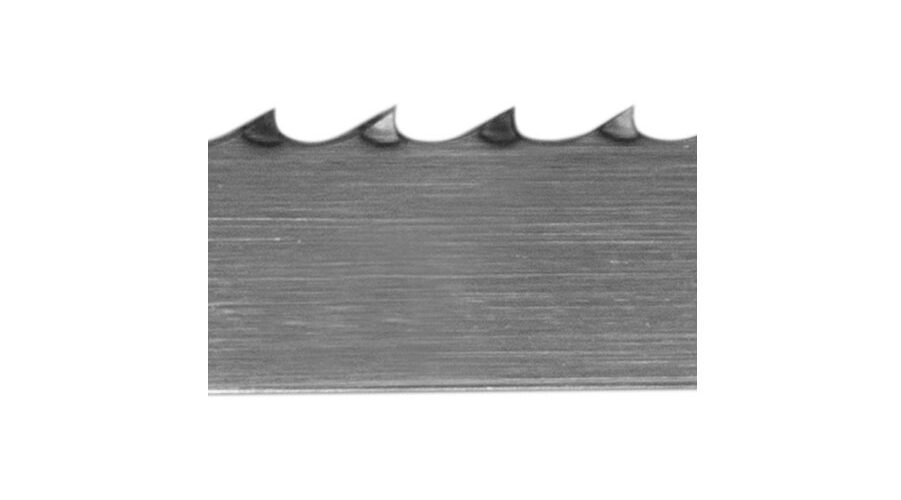
The 2200 mm bone band saw blade is made from laminated carbon steel with a special pearled tooth rated for double life. It matches saws taking a 2200 mm band and passes through bone with a clean cut and no residue. Supplied in a box of four blades.
Band type: BONE (4 TPI). Tooth size: 6.35 mm (4 teeth per inch). A very balanced option for bone-in meat and for improving the look of the cut. Especially suited to machines with a linear speed below 20 m/s. Dimensions: 2,200 × 16 × 0.50 mm (length × width × thickness).
What a 2200 mm bone blade is used for
This is the bone version for cutting-room machines. In that environment bone cutting is continuous and the pieces are large, so the band becomes a consumable with a predictable turnover rather than something you change when it fails.
- Cutting room: separating sections from quarters and carcasses.
- Meat industry: line cutting of product that has not been boned.
- Abattoirs: primary bone-in breaking down.
- Large preparation room: whole loin and rib racks.
- Handling centres: preparing pieces for distribution.
Technical specifications
| Band length |
2,200 mm |
| Dimensions |
2,200 × 16 × 0.50 mm (length × width × thickness) |
| Tooth type |
4 TPI (4 teeth per inch) |
| Tooth size |
6.35 mm (4 teeth per inch) |
| Teeth per inch (TPI) |
4 |
| Recommended use |
Bone-in meat: a very balanced option that improves the look of the cut. |
| Machine speed |
Especially suited to machines with a linear speed below 20 m/s |
| Application |
Cutting bone |
| Material |
Laminated carbon steel |
| Tooth profile |
Special pearled tooth, double life |
| Cut finish |
Clean, no residue |
| Performance |
High |
| Supply |
Box of 4 blades |
Planning band supply as a consumable
In a cutting room, band consumption is predictable: it depends on kilos processed and on the type of bone. Turning that figure into a replenishment pattern, so many bands a week on a scheduled change, avoids the scenario that costs most, which is discovering mid-morning that there is no spare.
That planning also reads as a safety measure. A scheduled change guarantees you never work with a blade at its limit, which is exactly when the operator starts forcing the piece. Record the changes for a few weeks against the kilos processed and the pattern becomes quite stable, as long as the type of product does not vary much.
What the supply includes
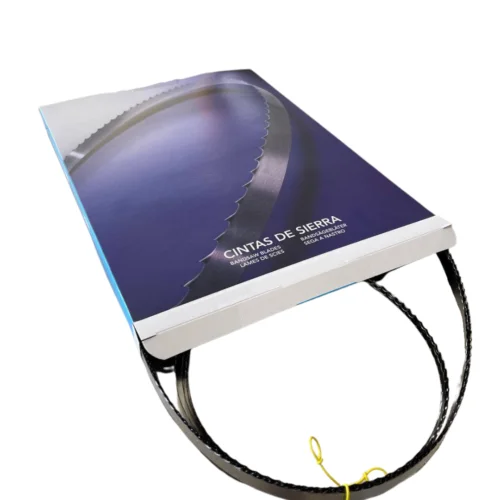
Box of four 2200 mm band saw blades for cutting bone.
This length is also available in a fresh meat version and in a frozen version.
Frequently asked questions
Which band do I need: meat, bone or frozen?
It depends on what you cut and on your saw’s linear speed (it is in the manual; if you do not know it, call us on +34 967 219 649 with the make and model). The three versions, in this length:
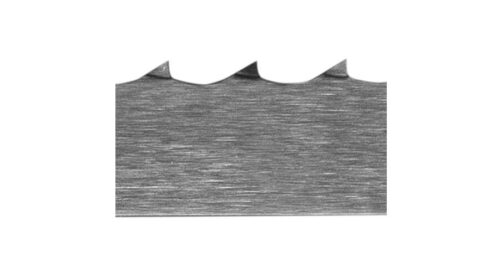
- MEAT (half-moon): 7 mm (half-moon) tooth. Recommended for fresh meat. Dimensions: 2,200 × 16 × 0.40 mm (length × width × thickness). See the 2,200 mm meat band.
- BONE (4 TPI): 6.35 mm (4 teeth per inch) tooth. A very balanced option for bone-in meat and for improving the look of the cut. Especially suited to machines with a linear speed below 20 m/s. Dimensions: 2,200 × 16 × 0.50 mm (length × width × thickness). (this blade)
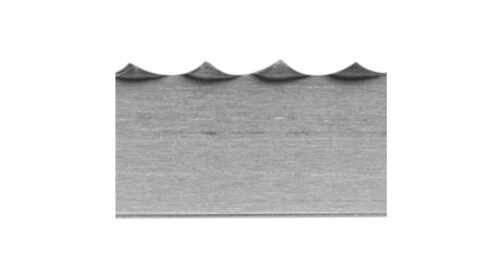
- FROZEN (3 TPI): 8.46 mm (3 teeth per inch) tooth. Recommended for frozen product: a more aggressive cut and high production volume. Works especially well on machines with a linear speed above 20 m/s. Dimensions: 2,200 × 16 × 0.50 mm (length × width × thickness). See the 2,200 mm frozen band.
How do I work out my band consumption?
Record the changes over a few weeks and relate them to the kilos processed. That gives a fairly stable pattern, provided the type of product does not change much from one period to the next.
Is scheduled supply worth setting up?
In production with steady volume, yes: it stops you running out and lets you hold only the stock you need. The interval can be set to whatever suits your consumption.
How much band stock should I hold?
Enough to cover the replenishment lead time with margin. In a cutting room, running out of a band for the main machine means stopping a line, so the margin should be generous.
Do stored bands deteriorate?
Kept properly, in their box, somewhere dry and with no weight on top, they last indefinitely. What ruins them is damp, which rusts carbon steel, and crushing, which deforms them.
Does the type of bone affect consumption?
Considerably. Adult beef wears the tooth far more than pork or lamb. If your production shifts species by season, band consumption will shift with it.
How do I know what blade length my saw needs?
The number in the product name (1600, 1820, 2330…) is the blade length in millimetres, and it must match exactly the length specified by your saw’s manufacturer on the rating plate or in the manual. If you have no documentation, measure the old blade laid out along its full circumference. Bernad® can help you confirm the length your machine takes.
Other lengths and blade types